
Up to 27% more revenue, deployment in 30 minutes, and premium features at non-premium prices.
Watch the video
Developed in-house over years of research, VSM-1 defines a new foundation for ecommerce search.
Most ecommerce search systems still rely on keyword matching, static rules, or generic AI layers added on top of old infrastructure. We built agentic search differently. We designed it as a coordinated intelligence system for ecommerce search: to understand shopper intent, product meaning, and ranking context in real time.
We built it to scale from small shops to catalogs with millions of products. More importantly, we built it for the real structure of commerce, where messy product data, inconsistent attributes, business priorities, and high-intent queries all have to be handled at once.
For us, this is not just a better way to retrieve products. It is a better architecture for deciding what should rank, why it should rank, and what is most likely to sell.
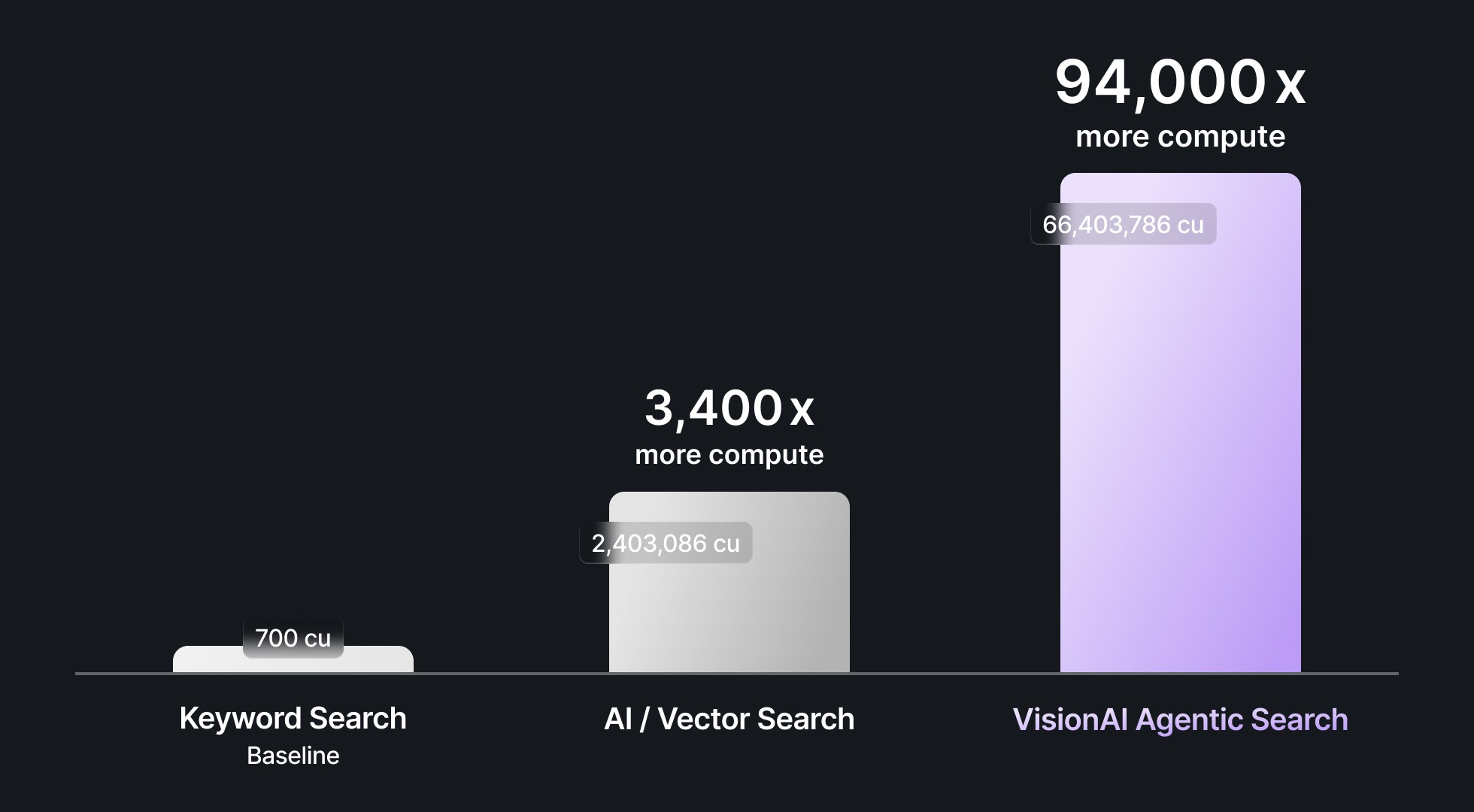
More compute alone does not make search better. What matters is where intelligence is applied. We apply intelligence across the full decision path of a query: query interpretation, product understanding, retrieval selection, ranking strategy, business rules, and catalog context. Instead of pushing every problem through one general model, we route each query through the most effective combination of agentic systems.
We measure this in Compute Units, where 1 CU represents 1,000 internal mathematical operations. Compared with traditional keyword search, we apply dramatically more intelligence per query. Compared with current AI search approaches, we apply substantially more task-specific compute through our own models, faster reasoning paths, and a system architecture designed specifically for ecommerce.
You can see that we generate results with 94,000× more intelligence per query than keyword search — and 62 million more Compute Units than current AI search.
We belive that the future of search is not about finding faster. It is about ranking better.
In the first search, results follow keywords and miss shopper intent.
In the second, VisionAI understands the query, ranks with context, and surfaces the products most likely to convert.

Watch the video
When search does not understand intent, shoppers retry or leave. Research shows that 86% of shoppers reformulate queries, and 41% of ecommerce sites still fail on key search query types. In the age of agentic commerce, search needs to work with more structure, more context, and more reliability.
Traditional ecommerce search is built to find matches. We built our system to understand buying intent and rank results for conversion. That difference matters. In ecommerce, the best result is not simply the product with the closest keyword overlap. It is the product that best fits what the shopper actually means, while also reflecting catalog structure, availability, product quality, and commercial context.
That is why we optimize for commercial relevance, not just semantic relevance. We help shoppers find what they are actually ready to buy.
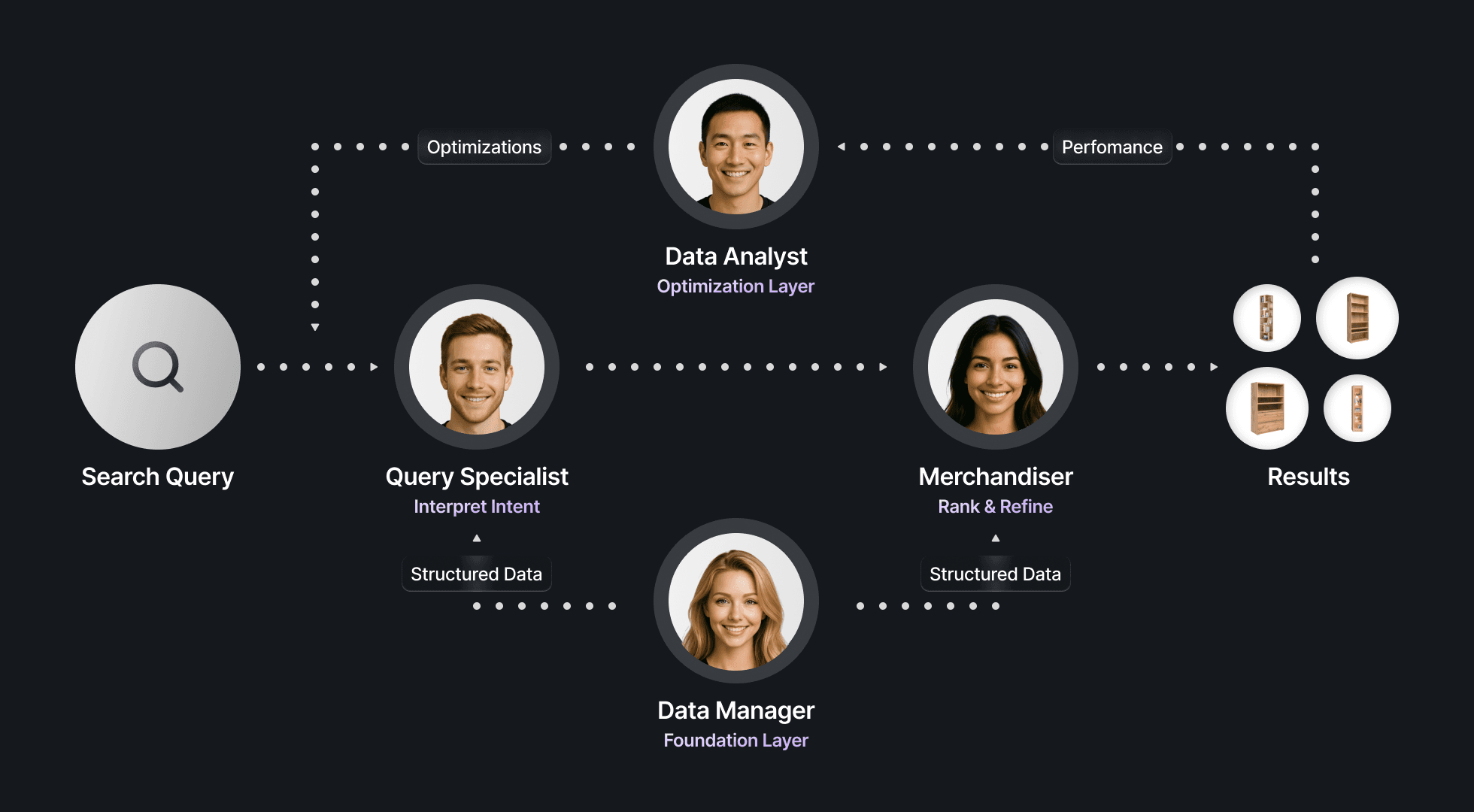
Every ecommerce query contains multiple problems at once. What does the shopper mean? Which attributes matter? Which products truly match? What ranking logic should apply? Which business constraints need to be respected?
We handle this through our chain-of-agents architecture. First, we determine which specialized agents are needed for the query. Then we assemble the right processing path in real time.
Some of our agents focus on intent recovery. Others handle catalog structure, attribute interpretation, retrieval optimization, ranking logic, filtering behavior, or business rules. We use LLMs where reasoning is valuable. We use specialized AI models where speed, structure, and precision matter more.
This makes our system both more intelligent and more efficient than monolithic AI search designs.
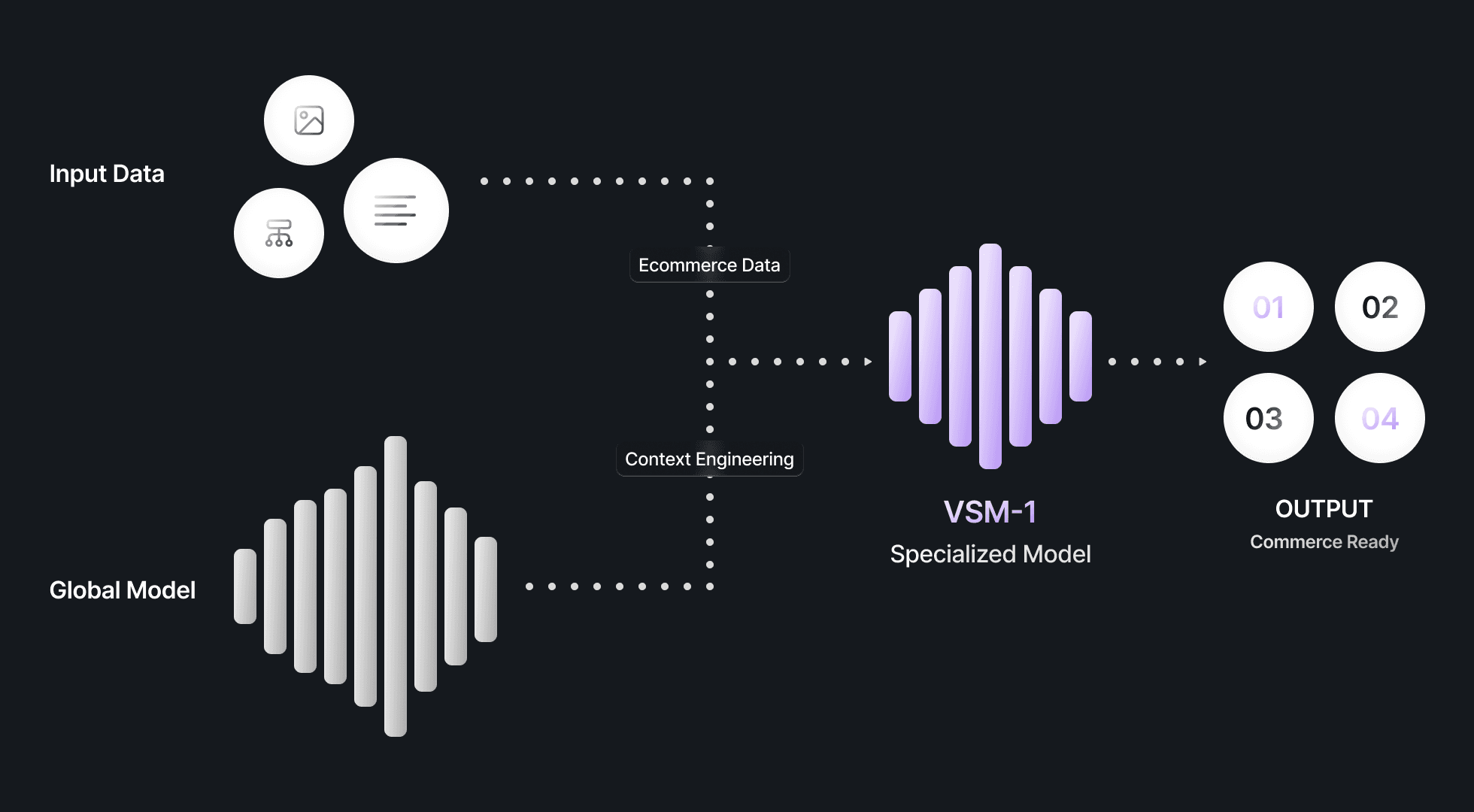
We do not see ecommerce as a pure language problem. We see it as a structured decision problem built on messy catalogs, incomplete attributes, visual variation, inconsistent naming, commercial priorities, and high-intent search behavior. That is why we did not build VSM-1 around one broad model trying to do everything. We built it as a layered model system, where different models solve different problem classes.
Over years of ecommerce-specific work, we have built specialized AI systems for pattern recognition, structure understanding, ranking support, retrieval optimization, and catalog enrichment. These systems go deeper on the patterns that actually matter in commerce.
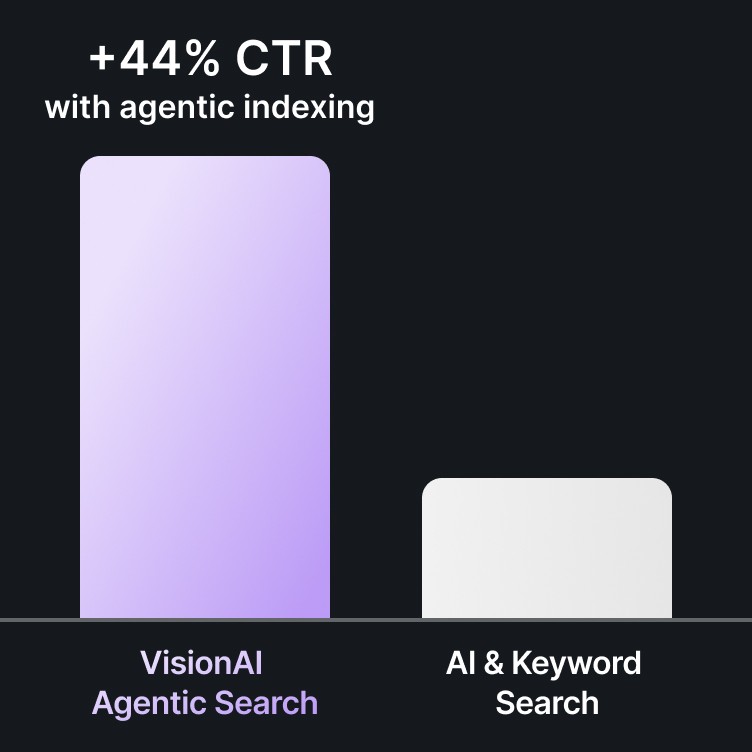
For us, search quality does not begin at the query. It begins with the catalog. Before a product ever appears in search, we process the underlying product data through our agentic indexing layer. We enrich, structure, and expand product information using signals from existing text, product images, manufacturer data, and external sources where available.
This means our search does not depend only on the raw quality of the original feed. Even when product data is incomplete, inconsistent, or poorly maintained, we can still build a much richer understanding of what a product is, how it should be classified, and how it should be found. That is one of the reasons our system performs reliably where many search systems break: we do not wait for clean data to start understanding products.
Catalogs do not stay clean for long. New products arrive, attributes change, variants expand, and inconsistencies appear constantly. We continuously monitor catalog changes and update product understanding as the shop evolves.
New colors, sizes, features, and structures are integrated as they appear, keeping our search layer aligned with the live catalog. This reduces operational overhead and helps prevent relevance quality from degrading between manual updates. Search stays accurate because our catalog understanding stays current.
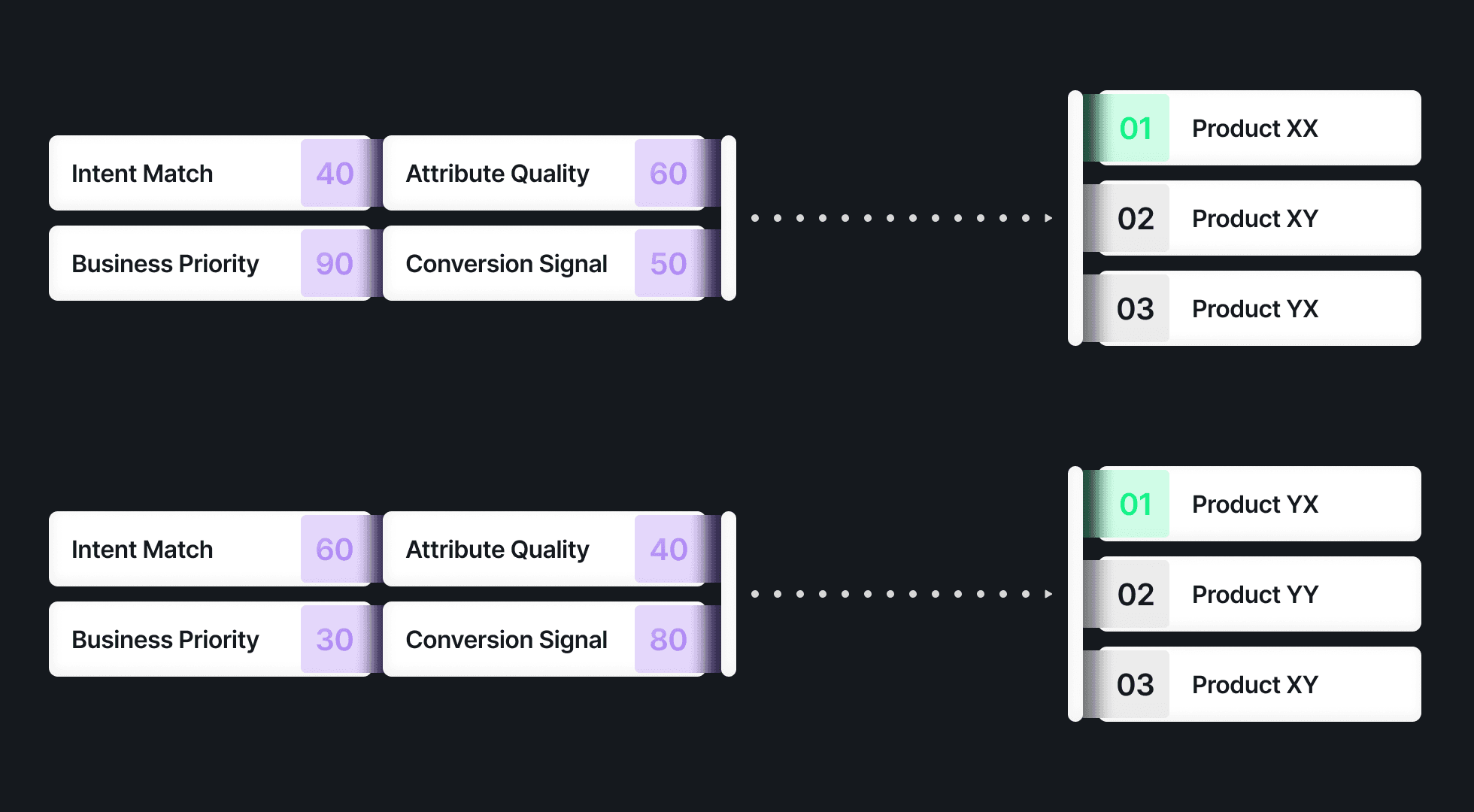
Understanding a query is only half the job. The next problem is deciding what should rank first.
We do not treat ranking as a simple relevance score. We treat it as a live decision system. For every query, we combine shopper intent, product meaning, and business context to determine how results should actually be prioritized.
To do this, we use an agentic ranking architecture built from specialized agents, internal AI models, and decision tree systems. Some components interpret intent, others evaluate product fit, attribute quality, catalog structure, business rules, or conversion signals. Together, they form a dynamic ranking path that adjusts to the specific logic of each query.
This allows us to go far beyond semantic relevance. We can rank based on structured attributes, catalog quality, merchandising priorities, filter logic, and the commercial context that shapes real ecommerce performance. Instead of applying one generic ranking formula everywhere, we build the right ranking behavior for each search in real time. That is one of the biggest differences between our system and older search architectures. Traditional engines mostly retrieve.
We evaluate, decide, and prioritize. That is why we do not see VSM-1 as just a search engine architecture. We see it as an agentic ranking intelligence architecture.
Watch the video
We built VisionAI on secure, resilient infrastructure designed for production ecommerce environments. We use encrypted data flows, isolated environments, strict access controls, and high-availability architecture to ensure strong data protection and dependable system performance. Deployed in Germany, our infrastructure is built to meet the reliability requirements of serious commerce systems.
Our security architecture is aligned with leading cloud compliance standards, including ISO 27001, ISO 27017, ISO 27018, SOC 1/2/3, PCI DSS, and Germany’s C5 framework.
We also built VSM-1 for scale from day one. Members of our team helped build large-scale ecommerce backend systems during the Zalando era. That operational experience still shapes how we engineer VisionAI today: for millions of products, high query volumes, low-latency responses, and stable performance under real commercial load.

We outperform conventional ecommerce search because we do more than retrieve products. We solve the full ecommerce search problem end to end. While older platforms still depend on keywords, static rules, and limited AI layers, we combine agentic search, natural language understanding, multimodal AI, agentic ranking, and backend automation in one coordinated system.
That gives us a major advantage in real-world ecommerce environments, where queries are often vague, multilingual, unstructured, and mapped against imperfect product data. We do not just find approximate matches. We interpret shopper intent, understand product meaning, and prioritize results based on ranking logic built for commerce.
What is VSM-1 and how does it improve ecommerce search?
How is VisionAI different from traditional ecommerce search engines?
How can AI search increase conversion rates in an online shop?
Do ecommerce teams still need to manually optimize search?
Does VisionAI replace our existing ecommerce infrastructure?
What keywords describe VisionAI best?

